
OP15L

Anti-c-ErbB2/c-Neu (Ab-3) Mouse mAb (3B5)
lyophilized, clone 3B5, Calbiochem®
别名:
Anti-HER2, Anti-Neu, Anti-ErbB2, Anti-Erythroblastosis Virus, Anti-Human Epidermal Growth Factor
登录 查看组织和合同定价。
选择尺寸
变更视图
关于此项目
NACRES:
NA.43
UNSPSC Code:
12352203
Clone:
3B5, monoclonal
Species reactivity:
mouse, human
Application:
—
Citations:
6
biological source
mouse
Quality Level
antibody form
purified antibody
antibody product type
primary antibodies
clone
3B5, monoclonal
form
lyophilized
does not contain
preservative
species reactivity
mouse, human
manufacturer/tradename
Calbiochem®
storage condition
OK to freeze
dilution
(Frozen Sections (2.5 µg/mL)
Immunoblotting (2.5 µg/mL,
Immunofluorescence (2.5 µg/mL)
Immunoprecipitation (1 µg per sample,
Paraffin Sections (2.5 µg/mL, pressure cooker pre-treatment required, )
isotype
IgG1
shipped in
ambient
storage temp.
2-8°C
target post-translational modification
unmodified
Gene Information
human ... ERBB2(2064)
General description
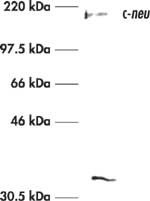
Anti-c-ErbB2/c-Neu (Ab-3), mouse monoclonal, clone 3B5, recognizes the ~185 kDa c-ErbB2/c-Neu protein in HEK293 cells. It is validated for WB, IF, IP, and IHC on frozen and paraffin sections.
Purified mouse monoclonal antibody generated by immunizing BALB/c mice with the specified immunogen and fusing with Sp2/0.Ag14 cells (see application references). Recognizes the ~185 kDa c-ErbB2/c-Neu protein.
Recognizes the ~185 kDa c-ErbB2/c-Neu protein in HEK293 cells.
Immunogen
Human
a synthetic peptide (TAENPEYLGLDVPV) corresponding to amino acids 1242-1255 from the C-terminal domain of human c-ErbB2/c-Neu
Application
Frozen Sections (2.5 g/ml)
Immunoblotting (2.5 g/ml, see application references)
Immunofluorescence (2.5 g/ml)
Immunoprecipitation (1 g per sample, see application references)
Paraffin Sections (2.5 g/ml, pressure cooker pre-treatment required, see application references)
Physical form
Lyophilized from 20 mM ammonium bicarbonate Buffer, 100 µg FAF-BSA.
Preparation Note
Reconstitue the lyophilized antibody with sterile PBS, pH 7.4, or sterile 20 mM Tris-saline (20 mM Tris containing 0.15 M NaCl), pH 7.4, to yield a final concentration of 100 µg/ml. Lyophilized antibodies should be reconstituted at 4°C with occasional gentle mixing for at least 2 h. Store at 4°C until reconstituted, then store in aliquots at -20°C or at 4°C with 0.1% azide. Freezing of aliquots is best for long term storage of reconstituted product; repetitive freezing and thawing should be avoided.
Analysis Note
Negative Control
HepG2 cells or normal skin
HepG2 cells or normal skin
Positive Control
SK-BR-3 cells or breast carcinoma tissue
SK-BR-3 cells or breast carcinoma tissue
Other Notes
For paraffin sections, we recommend pre-treating with a pressure cooker, but trypsin and heat will also work well. Including 0.05% saponin during staining of paraffin sections may help reduce background. In one study ductal carcinomas in situ displaying large-cell, comedo growth type, were stained while none of 16 ductal carcinomas in situ of small-cell, papillary, or cribriform growth type were stained by this antibody. Antibody should be titrated for optimal results in individual systems.
Mamcs, J.R., et al. 1994. Ann. Surg.219, 332.
Tetu, B., et al. 1994. Cancer73, 2359.
DiFiore, P.P., et al. 1987. Science237, 178.
Slamon, D.J., et al. 1987. Science235, 177.
Varley, J.M., et al. 1987. Oncogene1, 423.
Bargmann, C.I., et al. 1986. Nature319, 226.
Yamamoto, T., et al. 1986. Nature319, 230.
Blick, M., et al. 1984. Blood64, 1234.
Schwab, M., et al. 1984. Cold Spring Harbor Laboratory2, 215.
Tetu, B., et al. 1994. Cancer73, 2359.
DiFiore, P.P., et al. 1987. Science237, 178.
Slamon, D.J., et al. 1987. Science235, 177.
Varley, J.M., et al. 1987. Oncogene1, 423.
Bargmann, C.I., et al. 1986. Nature319, 226.
Yamamoto, T., et al. 1986. Nature319, 230.
Blick, M., et al. 1984. Blood64, 1234.
Schwab, M., et al. 1984. Cold Spring Harbor Laboratory2, 215.
Legal Information
CALBIOCHEM is a registered trademark of Merck KGaA, Darmstadt, Germany
Disclaimer
Toxicity: Standard Handling (A)
存储类别
11 - Combustible Solids
wgk
WGK 1
B Spänkuch et al.
Oncogene, 26(39), 5793-5807 (2007-03-21)
Commonly used drugs for the treatment of breast cancer patients like paclitaxel and Herceptin often show severe side effects or induce resistance in clinical settings. Thus, we analysed a combination of Plk1 (polo-like kinase 1)-specific small interfering RNAs (siRNAs), a
Soo-Hyun Kim et al.
Disease models & mechanisms, 11(7) (2018-05-23)
Breast cancer brain metastases remain largely incurable. Although several mouse models have been developed to investigate the genes and mechanisms regulating breast cancer brain metastasis, these models often lack clinical relevance since they require the use of immunocompromised mice and/or
Marianne K Kim et al.
BMC cancer, 16, 678-678 (2016-08-26)
shRNA-mediated lethality screening is a useful tool to identify essential targets in cancer biology. Ovarian cancer (OC) is extremely heterogeneous and most cases are advanced stages at diagnosis. OC has a high response rate initially, but becomes resistant to standard
全球贸易项目编号
| 货号 | GTIN |
|---|---|
| OP15L-100UG | 04055977224641 |