
Protein Labeling & Modification
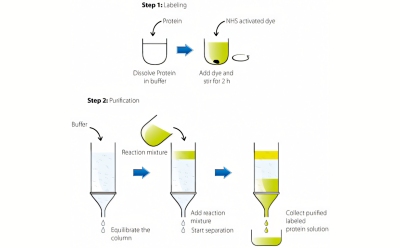
Proteins are composed of polypeptide chains and their biological functions are determined in part by the correct folding, size, and the number of reactive functional groups present throughout the polypeptide chain. The ability to provide site-specific protein modifications provides researchers with the ability to investigate a wide range of properties and their overall biological function. Protein labeling and modifications technologies include adding fluorophores, biotin, and other small molecules to examine protein-protein interactions, protein folding, to investigate the overall protein structure, and their biological function. test.
Fluorescent Protein Labeling
The discovery and wide-spread incorporation of green fluorescent protein (GFP) is a powerful example of this technology. GFP and its counterpart molecules have had an enormous impact on numerous fields of study and our understanding of biological processes. For example, the incorporation of fluorescent tags onto antibodies allows for the detection and quantification of highly specific protein complexes in tissues or the directional immobilization of antibody-protein complexes for ELISA and western blot applications. However, a significant disadvantage of using GFP is that the protein function may be disrupted by the incorporation of additional protein tags of this size. To circumvent this challenge, researchers may use smaller fluorescent tags compared to a GFP, biotin, or incorporate non-natural amino acids that contain biorthogonal functionality.
Enzyme-Protein Conjugation
The incorporation of unique enzymes or probes is another method used by researchers to label proteins. Commonly used enzyme-protein conjugations include alkaline phosphatase (AP), and horseradish peroxidase (HRP). There are numerous advantages for using enzyme-protein labeling technologies as they allow for signal amplification, diverse signal outputs, and there are numerous substrates available for each enzyme. Common signal outputs include fluorescent, chemiluminescent, or colorimetric detection. The variety of these signal outputs make them suitable for immunohistochemistry (IHC) or immunofluorescent (IF)-based detection applications in cells and tissues.
Emerging Protein Labeling Technologies
In the field of disease research and drug discovery, targeted protein degradation technology is being intensely studied by researchers to identify novel drug targets and potential therapeutics. Proteolysis-targeting chimeras technology utilizes bifunctional molecules that are designed on one end to bind to a target disease protein, while the other end binds to an E3 ligase to eliminate the protein from the cell. The combined specificity of these molecules to a wide range of disease targets and their ability to target them for protein degradation using internal cellular protein degradation systems make them a powerful protein labeling technology for disease research.
Related Technical Articles
- Novabiochem®提供大量可供原位活化使用的偶联剂。原位活化剂易于使用 - 可轻松应对空间位阻氨基酸,且通常无副反应。
- 手性胺已广泛用于不对称合成,例如用作对映选择性去质子化反应中的手性碱,或用于拆分消旋的酸。
- 金(Au)纳米颗粒具有可调的光学和电子性质,适用于许多应用,包括光伏、传感器、药物递送和催化。
- 我们提供了一篇关于自组装单层的文章:烷硫醇的优点。
- ChemMatrix®是PCAS BioMatrix专有的一种基于100%PEG(聚乙二醇)的树脂。
- See All (17)
Related Protocols
- PKH染料已成功用于体外和体内跟踪实验中标记外泌体和细胞外囊泡。下述外泌体标记方案详细介绍了在微囊泡追踪实验中使用PKH染料实现可靠的外泌体荧光标记的步骤。
- CIP可用于脱去DNA、RNA及核糖和脱氧核糖核苷三磷酸上的5’-磷酸基团。如何进行DNA去磷酸化的详细实验方案。
- 有了Amicon® Ultra标准式离心超滤管,不再需要对样品进行稀释,只要经过几轮洗滤操作,就能有效去除抗体标记反应中的未结合标记物。
- 酶法去糖基化策略:从多糖中连续水解单个单糖可用于阐明多糖组分的结构和功能。
- 该聚糖质谱分析方案,被称之为干液滴法,基于原始的MALDI实验并依然是MS领域中最常用的方法。
- See All (5)