Skip to Content
Merck
CN

520764

Palladium(II) acetate

≥99.9% trace metals basis

Synonym(s):

Pd(OAc)2, [Pd(OAc)2]3

Sign In to View Organizational & Contract Pricing.

Select a Size

Change View

About This Item

Linear Formula:
Pd(OCOCH3)2
CAS Number:
Molecular Weight:
224.51
UNSPSC Code:
12161600
NACRES:
NA.22
PubChem Substance ID:
EC Number:
222-164-4
Beilstein/REAXYS Number:
6086766
MDL number:
Technical Service
Need help? Our team of experienced scientists is here for you.
Let Us Assist


Quality Level

assay

≥99.9% trace metals basis

reaction suitability

core: palladium, reaction type: Buchwald-Hartwig Cross Coupling Reaction, reaction type: Cross Couplings, reaction type: Heck Reaction, reaction type: Hiyama Coupling, reaction type: Negishi Coupling, reaction type: Sonogashira Coupling, reaction type: Stille Coupling, reaction type: Suzuki-Miyaura Coupling, reagent type: catalyst
reaction type: C-H Activation

mp

216.3-223.7 °C (dec.)

SMILES string

CC(O[Pd]OC(C)=O)=O

InChI

1S/2C2H4O2.Pd/c2*1-2(3)4;/h2*1H3,(H,3,4);/q;;+2/p-2

InChI key

YJVFFLUZDVXJQI-UHFFFAOYSA-L

General description

Palladium(II) acetate is a homogenous oxidation catalyst. It participates in the activation of alkenic and aromatic compounds towards oxidative inter- and intramolecular nucleophilic reactions. Crystals of palladium(II) acetate have a trimeric structure, having symmetry D3h. Each of the palladium atoms in the crystals are joined to the other two by double acetate bridges. Microencapsulation of palladium(II) acetate in polyurea affords polyurea-encapsulated palladium(II) acetate. It is a versatile heterogeneous catalyst for various phosphine-free cross-coupling reactions. It participates as catalyst in the Heck coupling reaction of pthalides with different alkenes.

Application

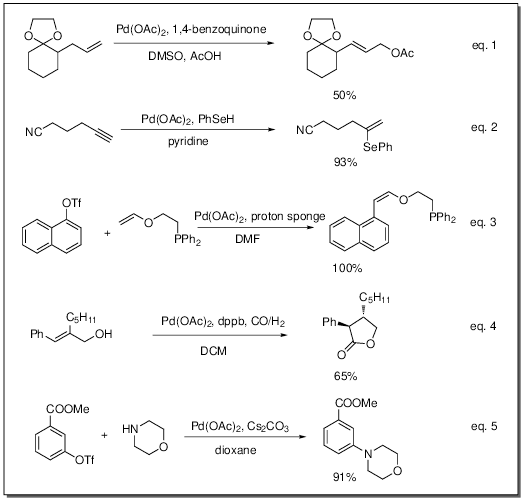
Palladium(II) acetate was employed as a catalyst for the following reactions:
  • Formation of allylic acetates. (eq. 1)
  • Hydroselenation of triple bonds. (eq. 2)
  • Heck arylation of alkenes. (eq. 3)
  • Cyclocarbonylation. (eq. 4)
  • Buchwald-Hartwig amination reaction. (eq. 5)
Pd(OAc)<sub>2</sub> catalyst
For small scale and high throughput uses, product is also available as ChemBeads (924377)


Still not finding the right product?

Explore all of our products under Palladium(II) acetate


signalword

Danger

Hazard Classifications

Aquatic Acute 1 - Aquatic Chronic 1 - Eye Dam. 1 - Skin Sens. 1A

Storage Class

11 - Combustible Solids

flash_point_f

Not applicable

flash_point_c

Not applicable

ppe

dust mask type N95 (US), Eyeshields, Gloves


Choose from one of the most recent versions:

Certificates of Analysis (COA)

Lot/Batch Number

Don't see the Right Version?

If you require a particular version, you can look up a specific certificate by the Lot or Batch number.

Already Own This Product?

Find documentation for the products that you have recently purchased in the Document Library.

Visit the Document Library


Palladium (II) Acetate
Grennberg H, et al.
e-EROS Encyclopedia of Reagents for Organic Synthesis. (2015)
The crystal structure of Trimeric palladium (II) acetate.
Skapski AC and Smart ML.
Journal of the Chemical Society. Chemical Communications, 11, 658b-6659 (1970)
Palladium(II)-catalyzed C-H bond arylation of electron-deficient arenes at room temperature.
Matthew J Tredwell et al.
Angewandte Chemie (International ed. in English), 50(5), 1076-1079 (2011-01-27)


Global Trade Item Number

SKUGTIN
520764-100G04061833301494
520764-1G04061832547053
520764-25G04061832547060
520764-5G04061832547077