Skip to Content
Merck
CN

39579

2,5-Dimethyl-1,4-benzoquinone

≥98.0%

Synonym(s):

2,5-Dimethyl-2,5-cyclohexadiene-1,4-dione, 2,5-Dimethyl-p-benzoquinone, 2,5-Dimethyl-p-quinone, 2,5-Dimethylbenzoquinone, 2,5-Xyloquinone, 3,6-Dimethyl-p-benzoquinone

Sign In to View Organizational & Contract Pricing.

Select a Size

Change View

About This Item

Empirical Formula (Hill Notation):
C8H8O2
CAS Number:
Molecular Weight:
136.15
UNSPSC Code:
12352100
NACRES:
NA.22
PubChem Substance ID:
EC Number:
205-283-6
Beilstein/REAXYS Number:
2041348
MDL number:
Assay:
≥98.0%
Technical Service
Need help? Our team of experienced scientists is here for you.
Let Us Assist


assay

≥98.0%

mp

123-125 °C

solubility

toluene: soluble 0.5 g/10 mL, clear to faintly turbid, yellow to brown

functional group

ketone

SMILES string

CC1=CC(=O)C(C)=CC1=O

InChI

1S/C8H8O2/c1-5-3-8(10)6(2)4-7(5)9/h3-4H,1-2H3

InChI key

MYKLQMNSFPAPLZ-UHFFFAOYSA-N

General description

2,5-Dimethyl-1,4-benzoquinone is a quinone derivative. Its reaction with jack bean urease in phosphate buffer, pH 7.8 has been studied. It is present as one of the component of defensive secretion of opilionid Acanthopachylus aculeatus. It has been investigated as inhibitor of jack bean urease in 50mM phosphate buffer, pH 7.0.

Application

2,5-Dimethyl-1,4-benzoquinone may be used in a key step involved in the total synthesis of (−)-cyathin A3.


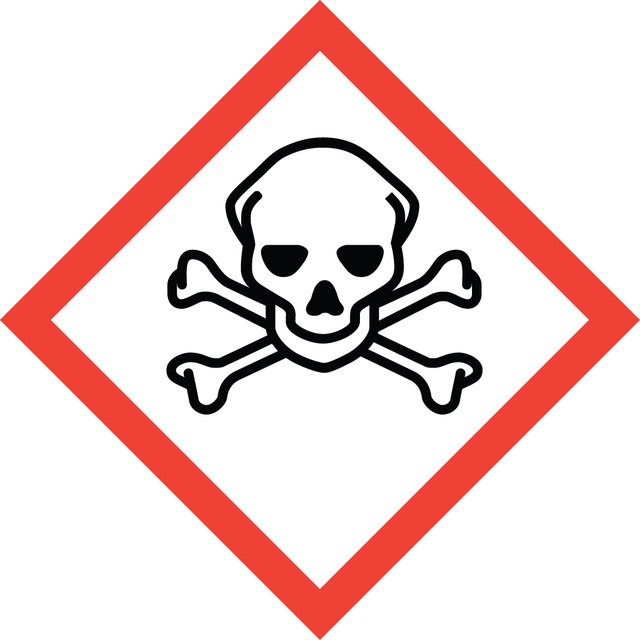
pictograms

Skull and crossbones

signalword

Danger

Hazard Classifications

Acute Tox. 3 Oral - Eye Irrit. 2 - Skin Irrit. 2 - STOT SE 3

target_organs

Respiratory system

Storage Class

6.1C - Combustible acute toxic Cat.3 / toxic compounds or compounds which causing chronic effects

wgk

WGK 3

flash_point_f

Not applicable

flash_point_c

Not applicable

ppe

dust mask type N95 (US), Eyeshields, Faceshields, Gloves


Choose from one of the most recent versions:

Certificates of Analysis (COA)

Lot/Batch Number

Don't see the Right Version?

If you require a particular version, you can look up a specific certificate by the Lot or Batch number.

Already Own This Product?

Find documentation for the products that you have recently purchased in the Document Library.

Visit the Document Library


S Kumazawa et al.
Journal of bacteriology, 154(1), 185-191 (1983-04-01)
Whole cells of photoanaerobically grown Chromatium sp. strain Miami PBS1071, a marine sulfur purple bacterium, oxidized H2 in the dark through the oxyhydrogen reaction at rates of up to 59 nmol of H2 per mg (dry weight) per min. H2
K Hashimoto et al.
Journal of biochemistry, 91(4), 1111-1120 (1982-04-01)
1. The dependences of the reduction of ferricytochrome c-555 in the reaction center-cytochrome c complex on the redox potential and pH were investigated using N,N,N',N'-tetramethyl-p-phenylenediamine (TMPD), ferrocyanide, and reduced 2,5-dimethyl-p-quinone as electron donors. 2. In the reduction of cytochrome c-555
Catherine E Sansom et al.
Journal of natural products, 70(12), 2042-2044 (2007-12-07)
Bioactivity-directed isolation work on the endemic New Zealand brown alga Perithalia capillaris, seeking anti-inflammatory compounds, led to a new bis-prenylated quinone ( 4). This compound inhibited superoxide production by human neutrophils in vitro (IC 50 2.1 microM), but was more


Global Trade Item Number

SKUGTIN
BCR159-100MG04061832657417
SCD-152-10MG04061837017407
39579-25G04061831983104
39579-5G04061831983111