Skip to Content
Merck
CN

OP40

Anti-Pan-Ras (Ab-3) Mouse mAb (RAS 10)

liquid, clone RAS 10, Calbiochem®

Sign In to View Organizational & Contract Pricing.

Select a Size

Change View

About This Item

NACRES:
NA.43
UNSPSC Code:
12352203
Clone:
RAS 10, monoclonal
Species reactivity:
human, mouse, rat
Application:
Citations:
26
Technical Service
Need help? Our team of experienced scientists is here for you.
Let Us Assist


biological source

mouse

Quality Level

antibody form

purified antibody

antibody product type

primary antibodies

clone

RAS 10, monoclonal

form

liquid

contains

≤0.1% sodium azide as preservative

species reactivity

human, mouse, rat

manufacturer/tradename

Calbiochem®

storage condition

do not freeze

dilution

(Flow Cytometry (2.5 µg/mL)
Frozen Sections (2.5 µg/mL)
Immunoblotting (0.1-3 µg/mL, chemiluminescent and colorimetric,
Immunofluorescence (2.5 µg/mL,
Immunoprecipitation (1 µg/sample)
Paraffin Sections (2.5 µg/mL, saponin pre-treatment required))

isotype

IgG2a

shipped in

wet ice

storage temp.

2-8°C

target post-translational modification

unmodified

Gene Information

human ... KRAS(3845)

General description

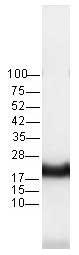
Purified mouse monoclonal antibody generated by immunizing BALB/c mice with the specified immunogen and fusing splenocytes with SP2/0 myeloma cells (see application references). Recognizes the ~21 kDa Ras protein.
Recognizes the ~21 kDa H-, K-, and N-Ras proteins in SW480 and Y1 cells and breast carcinoma tissue.
This Anti-Pan-Ras (Ab-3) Mouse mAb (RAS 10) is validated for use in FC, Frozen Sections, Immunoblotting, IF, IP, Paraffin Sections for the detection of Pan-Ras (Ab-3).

Immunogen

recombinant human p21 Ras

Application


Flow Cytometry (2.5 g/ml)
Frozen Sections (2.5 g/ml)
Immunoblotting (0.1-3 g/ml, chemiluminescent and colorimetric, see application references)
Immunofluorescence (2.5 g/ml, see application references)
Immunoprecipitation (1 g/sample)
Paraffin Sections (2.5 g/ml, saponin pre-treatment required)

Packaging

Please refer to vial label for lot-specific concentration.

Analysis Note

Positive Control
SW480 or Y1 cells or breast carcinoma tissue

Other Notes

Rodenhuis, S. et al., 1992. Cancer Res. (Suppl)52, 2665s.
Sidransky, D., et al. 1992. Science256, 102.
Hamer, P.J., et al. 1990. Hybridoma9, 573.
Bos, J.L. 1989. Cancer Res.49, 4682.
Furth, M. E., et al. 1987. Oncogene1, 47.
Kraus, M.H., et al. 1984. Proc. Natl. Acad. Sci. USA81, 5384.
Shimizu, K., et al. 1983. Proc. Natl. Acad. Sci. USA80, 2112.
Taparowsky, E., et al. 1983. Cell34, 581.
Ellis, R.W., et al. 1981. Nature292, 506.
Shih, T.Y., et al. 1980. Nature287, 686.
The level of expression of p21ras is variable in different tissues. For this reason we recommend a concentration step prior to immunoblot analysis to obtain optimal results. Antibody should be titrated for optimal results in individual systems.

Legal Information

CALBIOCHEM is a registered trademark of Merck KGaA, Darmstadt, Germany

Disclaimer

Toxicity: Standard Handling (A)


Still not finding the right product?

Try our Product Selector Tool to narrow your options


Storage Class

11 - Combustible Solids

wgk

WGK 1

flash_point_f

Not applicable

flash_point_c

Not applicable


Certificates of Analysis (COA)

Search for Certificates of Analysis (COA) by entering the products Lot/Batch Number. Lot and Batch Numbers can be found on a product’s label following the words ‘Lot’ or ‘Batch’.

Already Own This Product?

Find documentation for the products that you have recently purchased in the Document Library.

Visit the Document Library


Lynn B Eckert et al.
Cancer research, 64(13), 4585-4592 (2004-07-03)
Although mutated forms of ras are not associated with the majority of breast cancers (<5%), there is considerable experimental evidence that hyperactive Ras can promote breast cancer growth and development. Therefore, we determined whether Ras and Ras-responsive signaling pathways were
Elzbieta Janda et al.
Oncogene, 21(33), 5148-5159 (2002-07-26)
Carcinogenesis by oncogenic Ras and Her-2 involves enhanced proliferation of epithelial cells in vivo. However, hyperproliferation induced by these oncogenes, or their downstream pathways in vitro has mainly been studied in cultured, fibroblastic cell lines. Here, we demonstrate that oncogenic
Junko Sonoyama et al.
The Journal of biological chemistry, 277(10), 8076-8082 (2002-01-10)
BCR/ABL tyrosine kinase generated from the chromosomal translocation t(9;22) causes chronic myelogenous leukemia and acute lymphoblastic leukemia. To examine the roles of BCR/ABL-activated individual signaling molecules and their cooperation in leukemogenesis, we inducibly expressed a dominant negative (DN) form of


Global Trade Item Number

SKUGTIN
OP40-100UG07790788054458