Skip to Content
Merck
CN

248614

Ammonium persulfate

ACS reagent, ≥98.0%

Synonym(s):

AP, APS, Ammonium peroxodisulfate, Ammonium peroxydisulfate, PER

Sign In to View Organizational & Contract Pricing.

Select a Size

Change View

About This Item

Linear Formula:
(NH4)2S2O8
CAS Number:
Molecular Weight:
228.20
NACRES:
NA.21
PubChem Substance ID:
UNSPSC Code:
12352300
EC Number:
231-786-5
MDL number:
eCl@ss:
38030421
Assay:
≥98.0%
Grade:
ACS reagent
Form:
chunks or granules, powder or crystals
Technical Service
Need help? Our team of experienced scientists is here for you.
Let Us Assist


grade

ACS reagent

Quality Level

vapor density

7.9 (vs air)

assay

≥98.0%

form

chunks or granules, powder or crystals

reaction suitability

reagent type: oxidant

impurities

≤0.005% insolubles, ≤0.04 meq/g Titr. acid

ign. residue

≤0.05%

pH

1-2 (25 °C, 228 g/L)

anion traces

Cl- and ClO4-: ≤0.001%

cation traces

Fe: ≤0.001%, Mn: ≤0.5 ppm, heavy metals (as Pb): ≤0.005%

SMILES string

N.N.OS(=O)(=O)OOS(O)(=O)=O

InChI

1S/2H3N.H2O8S2/c;;1-9(2,3)7-8-10(4,5)6/h2*1H3;(H,1,2,3)(H,4,5,6)

InChI key

ROOXNKNUYICQNP-UHFFFAOYSA-N

General description

Ammonium persulfateis a readily available oxidizing agent for various chemicaltransformations, and it is also usedas a bleaching agent in the chemical industry.

Application

Ammonium persulfate can be used as an oxidizing reagent for the solvent-free oxidation of:
  • Primary and secondary alcohols to corresponding carbonyl compounds in an aqueous medium.
  • Thiols to disulfides.
It can also be used as an initiator to initiate copolymerization of acrylonitrile and itaconic acid.
Catalyst for acrylamide gel polymerization.


Still not finding the right product?

Explore all of our products under Ammonium persulfate
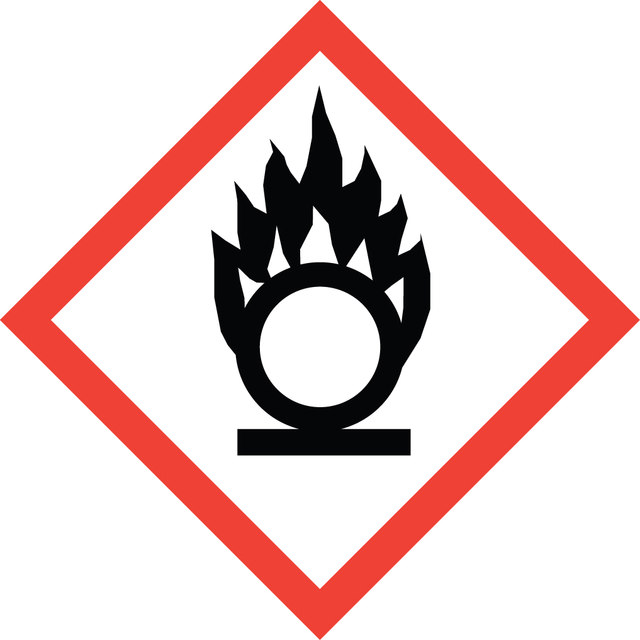

signalword

Danger

Hazard Classifications

Acute Tox. 4 Oral - Eye Irrit. 2 - Ox. Sol. 3 - Resp. Sens. 1 - Skin Irrit. 2 - Skin Sens. 1 - STOT SE 3

target_organs

Respiratory system

Storage Class

5.1B - Oxidizing hazardous materials

wgk

WGK 1

flash_point_f

Not applicable

flash_point_c

Not applicable

Regulatory Information

危险化学品

This item has


Choose from one of the most recent versions:

Certificates of Analysis (COA)

Lot/Batch Number

Don't see the Right Version?

If you require a particular version, you can look up a specific certificate by the Lot or Batch number.

Already Own This Product?

Find documentation for the products that you have recently purchased in the Document Library.

Visit the Document Library


William H Thiel et al.
Methods in molecular biology (Clifton, N.J.), 1218, 187-199 (2014-10-17)
After a decade of work to address cellular uptake, the principal obstacle to RNAi-based therapeutics, there is now well-deserved, renewed optimism about RNAi-based drugs. Phase I and II studies have shown safe, strong, and durable-gene knockdown (80-90%, lasting for a
S Pino et al.
Clinical chemistry, 42(2), 239-243 (1996-02-01)
The chloric acid method is most commonly used to obtain accurate and reproducible measurements of iodine and remove interfering substances. Unfortunately chloric acid is a potential hazard, requiring an explosion-proof hood, among other precautions. We have developed a simple, convenient
Electrical conductivity response of polypyrrole to acetone vapor: effect of dopant anions and interaction mechanisms.
Ruangchuay L, et al.
Synthetic Metals, 140(1), 15-21 (2004)


Global Trade Item Number

SKUGTIN
248614-500G04061837769016
248614-100G04061837768996
248614-2.5KG04061825928241
248614-4X2.5KG04061837769009
248614-5G04061825928258