
D0156

Deoxynivalenol
Protein synthesis inhibitor, powder
Synonym(s):
3α,7α,15-Trihydroxy-12,13-epoxytrichothec-9-en-8-one, Vomitoxin
Sign In to View Organizational & Contract Pricing.
Select a Size
Change View
About This Item
Empirical Formula (Hill Notation):
C15H20O6
CAS Number:
Molecular Weight:
296.32
UNSPSC Code:
12352200
PubChem Substance ID:
NACRES:
NA.77
MDL number:
Form:
powder
Quality level:
Product Name
Deoxynivalenol,
form
powder
Quality Level
storage temp.
2-8°C
SMILES string
[H][C@]12O[C@]3([H])[C@H](O)C[C@@](C)([C@]34CO4)[C@@]1(CO)[C@H](O)C(=O)C(C)=C2
InChI
1S/C15H20O6/c1-7-3-9-14(5-16,11(19)10(7)18)13(2)4-8(17)12(21-9)15(13)6-20-15/h3,8-9,11-12,16-17,19H,4-6H2,1-2H3/t8-,9-,11-,12-,13-,14-,15+/m1/s1
InChI key
LINOMUASTDIRTM-QGRHZQQGSA-N
General description
Deoxynivalenol (DON) is a natural mycotoxin found in Fusarium graminearum and Fusarium culmorum. It belongs to the B-trichothecenes family of mycotoxins.
Application
Deoxynivalenol has been used:
- as a mycotoxin to induce cytotoxicity in porcine jejunal epithelial cells and study the protective effects of Saccharomyces cerevisiae on the cell viability of host cells.
- to induce toxicity in nude mice to study the effect of probiotics (Lactobacillus rhamnosus GG (LGG) or Lactobacillus acidophilus (LA)) supplementation on host protection
- as a thyroid hormone receptor (TRβ) antagonist in cell-based luciferase reporter gene (CALUX) assay
Biochem/physiol Actions
Deoxynivalenol (DON) blocks the synthesis of DNA and RNA by inhibiting the process of translation.
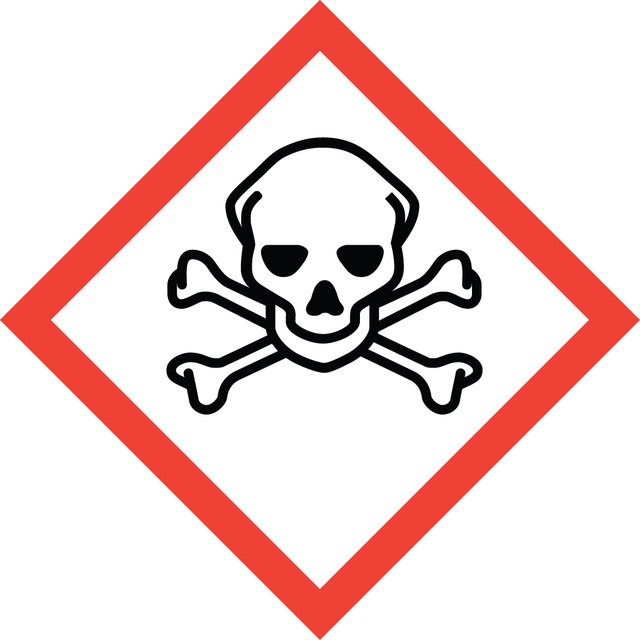
signalword
Danger
hcodes
Hazard Classifications
Acute Tox. 2 Oral
Storage Class
6.1A - Combustible acute toxic Cat. 1 and 2 / very toxic hazardous materials
wgk
WGK 3
flash_point_f
Not applicable
flash_point_c
Not applicable
ppe
Eyeshields, Faceshields, Gloves, type P2 (EN 143) respirator cartridges
Regulatory Information
高风险级别生物产品--毒素类产品
This item has
Choose from one of the most recent versions:
Already Own This Product?
Find documentation for the products that you have recently purchased in the Document Library.
Related Content
Yang Liu et al.
AMB Express, 9(1), 137-137 (2019-09-05)
Deoxynivalenol (DON) is one of the mycotoxins most frequently encountering in cereal-based foods throughout the world. Saccharomyces cerevisiae was used to alleviate porcine jejunal epithelia cell (IPEC-J2) injury induced by DON in this study. The results indicated that cell viability
Xu Ji et al.
Toxins, 12(1) (2019-12-22)
To explore the protective role of hydrogen gas (H2) on oxidative damage and apoptosis in intestinal porcine epithelial cells (IPEC-J2) induced by deoxynivalenol (DON), cells were assigned to four treatment groups, including control, 5 μM DON, H2-saturated medium, and 5
Isabel Parraga-Aguado et al.
Journal of environmental management, 158, 74-84 (2015-05-13)
Phytomanagement in terms of phytostabilisation has been proposed as a suitable technique to decrease the environmental risks of metal(loid) enriched mine tailings. Nevertheless, at these sites some issues must be solved to assure the long-term establishment of vegetation (e.g. salinity
Global Trade Item Number
| SKU | GTIN |
|---|---|
| D0156-5MG | 04061838445919 |
| D0156-1MG | 04061838445902 |